Cessna 150 and 152 Airspeeds: IAS, CAS, TAS and Groundspeed
Indicated airspeed, calibrated airspeed, true airspeed and groundspeed describe different quantities. In Cessna 150 and 152 research, preserving the speed definition is as important as preserving knots or miles per hour. Converting mph into knots changes the unit; it does not turn indicated airspeed into true airspeed. A useful comparison states both the kind of speed and the unit before interpreting the number.
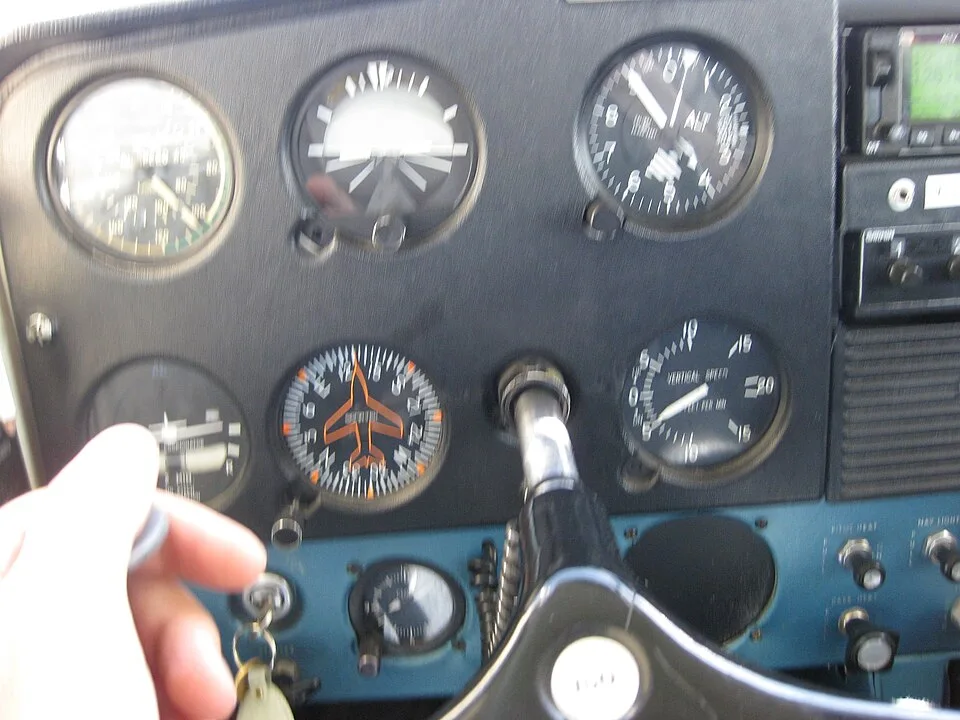

IAS and CAS: the indication and its correction
Indicated airspeed, or IAS, is the airspeed indicator's reading. Calibrated airspeed, or CAS, corrects indicated airspeed for instrument and position error. The aircraft's applicable airspeed-calibration information supplies the relationship, which can depend on configuration. It is not a universal offset that can be copied from another model or assumed constant across the speed range.
KIAS means knots indicated airspeed; KCAS means knots calibrated airspeed. Older publications may use miles per hour while retaining an indicated or calibrated basis. When a limit is stated on a calibrated basis, silently relabeling it as an instrument indication loses part of the meaning. Read the applicable manual's limitations and calibration information together, rather than attempting to reconstruct an operating limit from a summary table.

TAS: speed through the surrounding air
True airspeed, or TAS, describes the aircraft's speed relative to the air mass. KTAS expresses that speed in knots. Air density connects true airspeed with the quantities derived from the pitot-static system. At a given calibrated airspeed, changes in atmospheric conditions can change the corresponding true airspeed.
This is why cruise comparisons need altitude and temperature as well as power and weight. A published true cruise speed at altitude is not a promise of the same number on the airspeed indicator. The cruise-speed guide retains the conditions attached to historical figures. The density-altitude explanation connects the atmosphere to takeoff and climb without assuming that a single speed definition answers every performance question.
Groundspeed: progress along the route
Groundspeed describes motion relative to the ground. Wind changes the relationship between speed through the air and progress over the ground. Consequently, a GPS groundspeed observed on one flight is not a direct measurement of the airplane's still-air cruise performance. A favorable wind can increase progress without increasing the true airspeed produced by the selected power and configuration.
For travel planning, groundspeed helps determine time along the route. Endurance concerns time available from the fuel plan, while range concerns distance. The range guide explains the reserve and tank assumptions that must accompany a published distance. Comparing a wind-assisted observation with a handbook cruise figure mixes weather with aircraft performance.


Knots, mph and the site's unit control
A knot is a nautical mile per hour. A mile-per-hour figure uses statute miles. A unit conversion expresses the same quantity on another scale; it does not correct instrument error, account for density or remove wind. Keep the original speed type beside a converted value. The site's Metric and Imperial controls help read supported units, but they do not create an IAS-to-CAS calibration or a TAS-to-groundspeed flight calculation.
For a comparison worksheet, record the aircraft model, manual, speed name, speed basis, units, configuration and atmospheric or power conditions. A missing field should remain a question to resolve. Do not fill it with whichever assumption makes two numbers easiest to compare.
Operating speeds need their own applicability
A maneuvering, flap or never-exceed speed is a limitation with a specific definition and applicability. It is not interchangeable with maximum level-flight speed or a recommended climb speed. Aerobat and standard-model values should not be exchanged merely because the airplanes share an engine family. Follow the exact aircraft's approved information and supplements. The aviation glossary expands the abbreviations; the aircraft manual establishes the values and how they are used.