Cessna 150 and 152 Models: Generations, Aerobats and International Variants
Cessna 150 and 152 model names describe several related production lines. The U.S. standard 150 progresses through annual letters and later multi-year L/M generations; Aerobats use separate A150 and A152 identities; Reims-built aircraft use F, FA and FRA designations; Argentine production retains distinct hyphenated names and cross-referenced identifiers. This directory explains those relationships before directing you to the exact model reference.


For a chronological account, follow the Cessna 150 development history and the Cessna 152 introduction and production era. The Reims manufacturing history explains how the French branches developed alongside those U.S. models.
The useful first question is the official model on the aircraft's records. A year, engine horsepower or marketing name is not enough to select a certification group. Each table retains the model's country, category, engine context and certified serial eligibility. The linked model pages then explain what changed, which handbook families apply and where the evidence remains incomplete.
Follow the production branches
The family is easier to understand as several connected histories than as one alphabetized list. Along the U.S. standard line, the early fastback models lead to the rear-window D/E generation, the swept-tail F and later refinements, then the multi-year L/M aircraft and the 152. The U.S. Aerobat line begins later and follows its own sequence. Reims standard production has another sequence, while French Aerobat configuration rules require more than a simple previous-to-next arrow.
U.S. standard line
- 1501959-1960
- 150A1961
- 150B1962
- 150C1963
- 150D1964
- 150E1965
- 150F1966
- 150G1967
- 150H1968
- 150J1969
- 150K1970
- 150L1971-1974
- 150M1975-1977
- 1521978-1985
U.S. Aerobat line
Reims standard line
Early Reims Aerobats
Higher-power Reims Aerobats
Reims Aerobat in the 152 era
- FA1521978-1986
Argentine parallel identities
Read an ordered line as a progression of documented models, not a guarantee that every component changed at a model boundary. The 150B demonstrates a component change within a model; the 150C demonstrates a distinct model without an established major redesign. The 150F represents a larger coordinated change. All three kinds of step belong in an honest model history.
The links on individual profiles show only the neighboring models in their documented branch. They carry the standard U.S. M into 152, the U.S. Aerobat M into A152, and the standard French M into F152. The Argentine pair is presented as parallel standard/Aerobat identities. FA/FRA configuration relationships remain conditional, so a reader cannot mistake kit eligibility for an inevitable production or conversion path.
Choose a model question before a comparison
For a change in visible airframe generation, start with 150C versus 150D or 150E versus 150F. For a later mechanical generation, use 150K versus 150L. For the engine-family successor, use 150M versus 152. These answer different questions; an adjacent letter alone does not establish an equally substantial comparison.
A model profile also connects a historical designation with the physical airplane. The design article explains the shared structure, and the cabin article explains the occupied space. Those common explanations let the profiles concentrate on the particular generation, branch or installation instead of repeating an entire aircraft description for every suffix.
U.S. Standard 150 Generations
The original 150 covers 1959-1960 and establishes the early fastback, 1,500-lb group continued by 150A/B/C. Early annual changes include the 150A wheel/brake breakpoint and 150B landing-gear attachment change. A new letter does not necessarily mean a new gross weight or engine, so the model pages distinguish historical equipment refinements from certified limits.
The 150D introduces the Omni-Vision and 1,600-lb generation. The 150F then brings the swept tail and electric flaps, with its own narrower motor/relay and engine-mount effectivity. These are separate transitions: the higher gross weight did not begin with the electric-flap model. The 150G adds alternator and cabin/heating context, while later letters continue refinement without implying one universal equipment state.
The 150L spans 1971-1974 and the tubular-main-gear phase; multiple cabin, electrical and wheel changes occur within its range. The 150M covers the final 1975-1977 U.S. standard 150 generation. Their multi-year handbook and specification coverage should not be collapsed into one annual value. The 150-versus-152 comparison explains the succeeding engine and certified-weight transition.
| Official Model | Model Years | Country of Manufacture | Certification Category | Engine as Type-Certificated | Certified Serial Eligibility | Reference |
|---|---|---|---|---|---|---|
| 150 | 1959-1960 | United States | Utility | Continental O-200-A | 617; 17001-17999; 59001-59018 | [1] |
| 150A | 1961 | United States | Utility | Continental O-200-A | 628; 15059019-15059350 | [1] |
| 150B | 1962 | United States | Utility | Continental O-200-A | 15059351-15059700 | [1] |
| 150C | 1963 | United States | Utility | Continental O-200-A | 15059701-15060087 | [1] |
| 150D | 1964 | United States | Utility | Continental O-200-A | 15060088-15060772 | [1] |
| 150E | 1965 | United States | Utility | Continental O-200-A | 644; 15060773-15061532 | [1] |
| 150F | 1966 | United States | Utility | Continental O-200-A | 15061533-15064532 | [1] |
| 150G | 1967 | United States | Utility | Continental O-200-A | 15064533-15067198 except 15064970 | [1] |
| 150H | 1968 | United States | Utility | Continental O-200-A | 649; 15067199-15069308 | [1] |
| 150J | 1969 | United States | Utility | Continental O-200-A | 15069309-15071128 | [1] |
| 150K | 1970 | United States | Utility | Continental O-200-A | 15071129-15072003 | [1] |
| A150K | 1970 | United States | Acrobatic | Continental O-200-A | A1500001-A1500226 | [1] |
| 150L | 1971-1974 | United States | Utility | Continental O-200-A | 15072004-15075781 | [1] |
| A150L | 1971-1974 | United States | Acrobatic | Continental O-200-A | A1500227-A1500432; A1500434-A1500523 | [1] |
| 150M | 1975-1977 | United States | Utility | Continental O-200-A | 15075782-15079405 | [1] |
| A150M | 1975-1977 | United States | Acrobatic | Continental O-200-A | 15064970; A1500524-A1500734 | [1] |
| 152 | 1978-1985 | United States | Utility | Lycoming O-235-L2C through S/N 15285594; O-235-N2C from 15285595 and on, or aircraft reworked per SK152-15 / SK152-16 | 15279406-15286033 | [1] |
| A152 | 1978-1985 | United States | Acrobatic | Lycoming O-235-L2C through A1521014; O-235-N2C from A1521015 and on, or aircraft reworked per SK152-15 / SK152-16 | A1500433; 681; A1520735-A1521049 | [1] |
U.S. Aerobats and the 152 Family
The standard 150K has a different category from the Aerobat. A150K, A150L and A150M have separate U.S. serial sequences and Acrobatic-category limits. Standard and Aerobat annual summaries sometimes share a source, but an equipment example or operating limit retains its own label. The word Aerobat should be reconciled with the legal identity, applicable manual and loading documents rather than treated as a feature package on any standard 150.
The standard 152 and A152 follow in the 1978-1985 U.S. model-year groups. Their Lycoming O-235 factory context differs from the O-200-powered U.S. 150 line. L2C/N2C engine distinctions also depend on factory effectivity or approved rework, so a later-looking aircraft is not sufficient evidence of an N2C installation. The Aerobat guide covers the category relationships across both families.
Serial exceptions cross apparent model and family boundaries. Serial 15064970 belongs to A150M despite its numeric position in the 150G interval. A1500433 belongs to A152 rather than A150L. The 681/A15200681 notation case describes one aircraft identity, not two production entries. These examples explain why the serial research tool and both family serial guides preserve explicit exceptions before ordinary ranges.
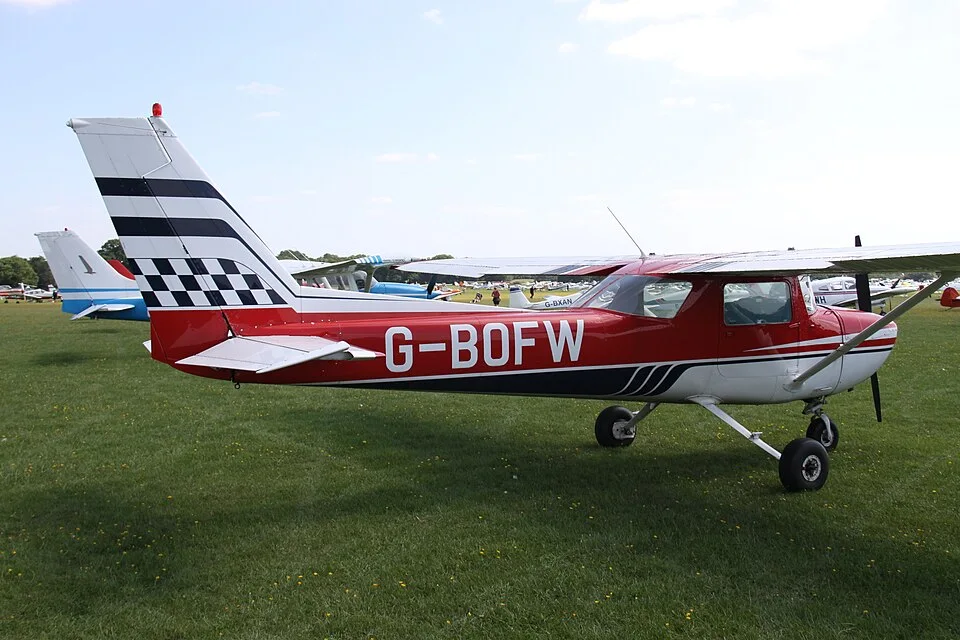

Reims Standard and Aerobat Lines
Reims standard F150 models have French manufacture and A13EU identity context. The F150F through F150J sequence uses the hyphenated F150-xxxx presentation; F150K introduces the later unhyphenated format. The prefix, punctuation and complete digits are useful identity evidence, not optional decoration to discard during a search. A common final letter does not import U.S. CG or performance approval.
FA150 and FA152 identify French Aerobat branches. FRA150L/M add a higher-power, configuration-sensitive relationship: eligible FA serials require the prescribed kits before the alternative certified identity is established. Dedicated Reims flight-manual families serve these aircraft. The Reims reference follows the certification and document distinctions in more depth, including the O-200/O-240/O-235 engine branches.
| Official Model | Model Years | Country of Manufacture | Certification Category | Engine as Type-Certificated | Certified Serial Eligibility | Reference |
|---|---|---|---|---|---|---|
| F150F | 1966 | France | Utility | Continental O-200-A | F150-0001-F150-0067 | [1] |
| F150G | 1967 | France | Utility | Rolls-Royce Continental O-200-A | F150-0068-F150-0219 | [1] |
| F150H | 1968 | France | Utility | Rolls-Royce Continental O-200-A | F150-0220-F150-0389 | [1] |
| F150J | 1969 | France | Utility | Rolls-Royce Continental O-200-A | F150-0390-F150-0529 | [1] |
| F150K | 1970 | France | Utility | Rolls-Royce Continental O-200-A | F15000530-F15000658 | [1] |
| FA150K | 1970 | France | Acrobatic | Rolls-Royce Continental O-200-A | FA1500001-FA1500081 | [1] |
| F150L | 1971-1974 | France | Utility | Rolls-Royce Continental O-200-A | F15000659-F15001143 | [1] |
| FA150L | 1971 | France | Acrobatic | Rolls-Royce Continental O-200-A | FA1500082-FA1500120 | [1] |
| FRA150L | 1972-1974 | France | Acrobatic | Rolls-Royce Continental O-240-A | FRA1500121-FRA1500261; or FA1500121-FA1500261 when equipped with FKA150-2311 and FKA150-2316 | [1] |
| F150M | 1975-1977 | France | Utility | Continental O-200-A | F15001144-F15001428 | [1] |
| FA150M | 1975-1977 | France | Acrobatic | Rolls-Royce O-240-A or O-240-E in the A13EU higher-power configuration | FA1500262-FA1500336 when equipped with FKA150-2311 and FKA150-2316 | [1] |
| FRA150M | 1975-1977 | France | Acrobatic | Rolls-Royce O-240-A or O-240-E (O-240-E noted for S/N FA00262 and on in A13EU) | FRA1500262-FRA1500336; or FA1500262-FA1500336 when equipped with FKA150-2311 and FKA150-2316 | [1] |
| F152 | 1978-1986 | France | Utility | Lycoming O-235-L2C for 1978-1982 models; O-235-N2C for 1983 model and on, or aircraft reworked per SK152-15 / SK152-16 | F15201429-F15201980 | [1] |
| FA152 | 1978-1986 | France | Acrobatic | Lycoming O-235-L2C for 1978-1982 models; O-235-N2C for 1983 model and on, or aircraft reworked per SK152-15 / SK152-16 | FA1520337-FA1520425 | [1] |
FA150M remains in this directory and in the FRA150M configuration explanation even though a separate base-model page is deferred. A model can be an established legal identity without enough independent technical relationships to justify another standalone article. That is preferable to presenting a second page that duplicates the conditional FRA story or silently borrows unsupported engine and serial data.
Argentine Production and Two Identifier Systems
Argentine A-150L is the standard local identity; A-A150L is the local Aerobat. Neither should be silently normalized into the U.S. A150L designation. The local serial and Cessna-assigned identifier are separate values connected by the ANAC and parts-catalog evidence at its stated precision.
| Official Model | Model Years | Country of Manufacture | Certification Category | Engine as Type-Certificated | Certified Serial Eligibility | Reference |
|---|---|---|---|---|---|---|
| A-150L | 1972-1973 | Argentina | Utility (service data context) | Continental O-200-A | A-1501001-A-1501039 | [1] |
| A-A150L | 1972-1973 | Argentina | Acrobatic (service data context) | Continental O-200-A | A-A1500001-A-A1500009 | [1] |
Some cross-references are exact pairs; others identify only block endpoints. An endpoint relationship does not establish every intermediate aircraft pairing, manufacture date or installed component. The Argentine serial discussion and ANAC reference preserve this distinction. A document search should retain both known identifiers rather than overwrite one with an inferred conversion.
How to Use a Model Page
Begin with the introduction and Quick Facts, then compare the ordinary ranges, exceptions and certification category. The detailed sections explain engine/propeller applications, year-qualified specifications, serial-break changes and handbook evidence. Standard U.S. pages often have more numerical coverage than the narrower French or Argentine references. An omitted exact relationship is not an invitation to copy a neighboring model's operating values.
For a purchase, continue from the model page to buying research and the prebuy evidence guide. For an operating-document search, use the 150 manuals or 152 manuals guide. For a loading question, the current aircraft report remains necessary alongside the certified group. The model directory establishes where to look; aircraft records establish what the individual machine is today.
Continue by technical subject
After identifying the model, explore performance, specifications, systems, engines, propellers, known issues and airworthiness directives. Each topic preserves the relevant configuration and source boundaries.
The 150C-to-150D comparison explains the rear-window and loading transition. The 150E-to-150F comparison separates the swept-tail redesign from the earlier cabin change. Approved 150 seaplane configurations form a different branch from ordinary landplane production.


Focused research
Use the curated comparison guide to follow meaningful generation, category and origin differences. It connects the model records through specific questions rather than ranking every possible pair.
Reading a model name before reading a specification
A Cessna model suffix identifies a certified model, while a model year describes its place in production history. Neither is a substitute for the aircraft's full serial number. Advertised year, registration year and approval date can answer different questions. The aviation glossary explains these terms together so that a buyer can move from an advertisement to the correct identity and then to the applicable technical pages.
The final 150M generation also includes the separately certified A150M Aerobat. Shared production years and an O-200-A engine do not make the two models interchangeable: the 150M versus A150M comparison explains the category distinction and unusual serial eligibility. Follow the official designation into the handbook and loading records before drawing conclusions from appearance or installed equipment.
Identify a particular aircraft
The Serial Number Decoder connects a complete serial with its supported model, exceptions and configuration conditions. Use the result to enter the relevant profile, then distinguish that production identity from the equipment installed today.
Explore this topic
- Cessna 150 Seaplane Configuration: Floats, Weight and Propeller Context - Understand the approved 150G/H/J/K float-configuration evidence without applying landplane loading and propeller assumptions.
- Cessna 150 and 152 Comparisons: Models, Engines and Buying Questions - Choose a focused Cessna 150/152 comparison by generation, Aerobat identity, Reims documentation, engine installation or aircraft-buying question.