AMC / Argentine Cessna A-A150L Aerobat Model Reference
The Argentine A-A150L is the documented local Aerobat identity. It remains distinct from the U.S. A150L even where technical literature uses related names. The local serial and Cessna-assigned serial should be retained as separate identifiers connected by evidence rather than silently treated as one identifier.
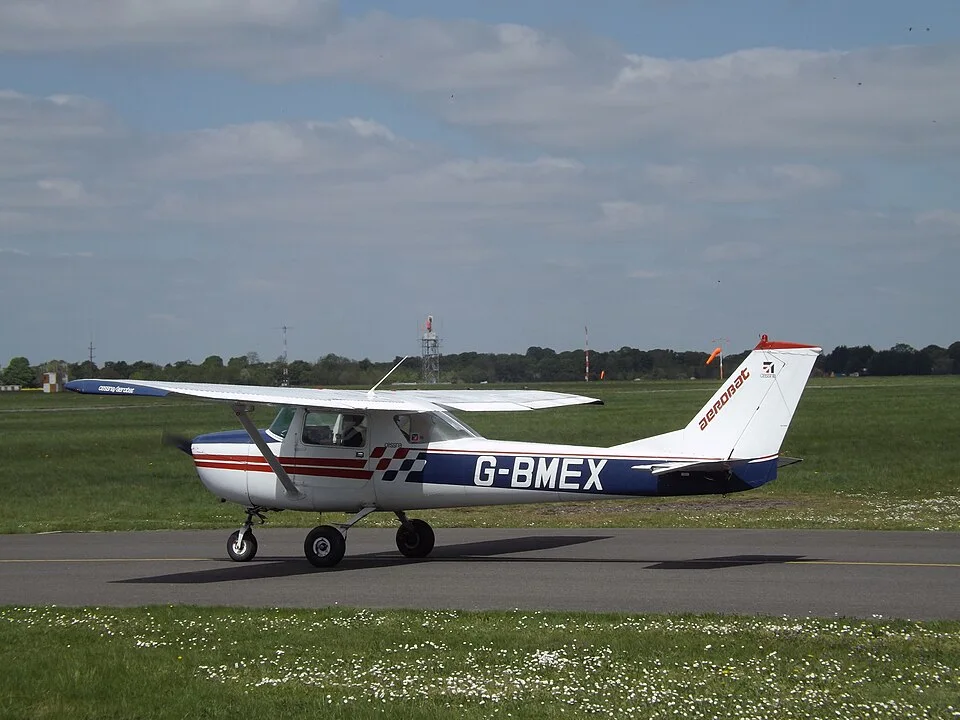

The Argentine Aerobat beside the local standard aircraft
A-A150L records the Aerobat side of the Argentine identities represented here for 1972-1973. The local standard counterpart is A-150L. These two names distinguish branches within the same documented period; a navigation system should not present one as the model that replaced the other. U.S. A150L offers related Aerobat context without becoming the same legal or local serial identity.
This profile's strongest evidence concerns how the local and Cessna identifiers are connected. The ANAC document reference preserves that relationship at the precision given, including assembly context where stated. Engine-group information supplies useful background, but exact local propeller and loading approval remain separate questions. The designation matters because it keeps those documentary relationships visible instead of allowing a familiar Aerobat name to conceal unresolved applicability.
| Model Years | 1972-1973 |
|---|---|
| Certification Category | Acrobatic (service data context) |
| Certified Serial Eligibility | A-A1500001-A-A1500009 |
| Type-design engine context | Continental O-200-A |
Generation and Certification
The ANAC cross-reference includes precision and assembly context where the source supplies it. Those details help connect aircraft records without establishing an approved flight manual, current installed equipment or a complete ownership history. The model-specific source relationships below preserve what is known and leave those aircraft-level questions open.
A-A150L is the Argentine Aerobat identity, with local eligibility A-A1500001-A-A1500009 for the documented 1972-1973 groups. Its doubled A and hyphen are meaningful parts of the designation, not duplicate typing to normalize away. It differs from the standard Argentine A-150L and from the U.S. A150L Aerobat. The small local interval makes exact cross-reference evidence especially valuable, but does not authorize assuming that every nearby Cessna serial has a corresponding local aircraft.
A-A150L is recorded as Aerobat in the Acrobatic (service data context) category, with model years 1972-1973 and approval context Not directly listed in FAA TCDS 3A19. The manufacturer entry is Área Material Córdoba (commonly associated with DINFIA/FMA in historical references); the manufacture/assembly location is Córdoba, Argentina. Its approval date is Consult the applicable aircraft approval, a model approval event rather than an individual aircraft's manufacture date.
| Model | TC | Category | Initial Model Approval Date | Core Cert Basis | Certification / Identity Note | Reference |
|---|---|---|---|---|---|---|
| A-A150L | Argentine local approval context | Acrobatic / service-data context | Consult the applicable aircraft approval | Base U.S. design lineage; exact Argentine certification basis requires the applicable aircraft approval | Confirm the applicable Argentine type-certificate number and certification basis from the aircraft’s approval records. | - |

Serial Numbers and Production
For A-A150L, the ordinary source assignments are 1972: A-A1500001 through A-A1500006; 1973: A-A1500007 through A-A1500009. The serial guide retains source conflicts and exceptional identities alongside these intervals.
| Model Year | Official Model | Serial Start | Serial End | Excluded / Override Serials | Notes | Primary Source |
|---|---|---|---|---|---|---|
| 1972 | A-A150L | A-A1500001 | A-A1500006 | - | ANAC cross-reference confirms AMC/DINFIA serial family and Cessna-assigned serial relationships. | [1] |
| 1973 | A-A150L | A-A1500007 | A-A1500009 | - | ANAC cross-reference confirms AMC/DINFIA serial family and Cessna-assigned serial relationships. | [1] |
| AMC / DINFIA Serial | Cessna-Assigned Serial | Mapping Precision | Assembly Note / Context | Mapping notes | Source |
|---|---|---|---|---|---|
| A-A1501001 | A1500333 | Exact | - | Exact pair printed by ANAC. | [1] |
| A-A1501002 | A1500334 | Exact | - | Exact pair printed by ANAC. | [1] |
| A-A1501003 | A1500335 | Exact | - | Exact pair printed by ANAC. | [1] |
| A-A1501004 | A1500337 | Exact | - | Exact pair printed by ANAC. | [1] |
| A-A1501005 | A1500338 | Exact | - | Exact pair printed by ANAC. | [1] |
| A-A1501006 | A1500339 | Exact | - | Exact pair printed by ANAC. | [1] |
| A-A1501007 through A-A1501009 | A1500366 through A1500377 | Block endpoints only | - | Middle exact pair not inferred. | [1] |
Engine, Propeller and Equipment Changes
The Argentine Aerobat cross-reference includes exact pairs, endpoint-only blocks and assembly context where supplied. Those evidence types should remain separate when reconciling a local plate with an imported component or Cessna document. The factory engine groups supply O-200 context, while the selected sources do not establish an exact A-A150L propeller or certified loading group. A U.S. Aerobat label on a handbook cannot fill that gap without an authority-supported relationship to the local aircraft.
The A-A150L factory installation groups specify 1972: O-200-A, 100 hp at 2750 RPM; 1973: O-200-A, 100 hp at 2750 RPM. An exact A-A150L propeller approval is not established by the application evidence presented here.
| Origin | Model Year | Aircraft Model | Factory Engine | Installed hp | RPM Limit | First Serial in Group | Last Serial in Group | Applicability Basis | Aircraft Source |
|---|---|---|---|---|---|---|---|---|---|
| Argentina | 1972 | A-A150L | O-200-A | 100 | 2750 | A-A1500001 | A-A1500006 | Factory / type-design | [1] |
| Argentina | 1973 | A-A150L | O-200-A | 100 | 2750 | A-A1500007 | A-A1500009 | Factory / type-design | [1] |


Manuals, Maintenance and Research
The ANAC Advertencia 286/DAG and Argentine parts-catalog references are practical starting points for identifying which numbering system a record uses. A matching pair establishes a connection between identifiers, not an approved flight manual, current configuration or complete ownership history. Keep acrobatic-category operations tied to the aircraft's controlling documents rather than importing A150L limits by name similarity. The adjacent standard Argentine reference helps resolve the most consequential ambiguity: whether a document concerns A-150L or A-A150L at all.