Cessna 150 Fuel Capacity and Tank Configurations
Cessna 150 fuel capacity must be read as a configuration-specific specification. Total capacity, usable fuel, unusable fuel and a performance calculation's fuel basis are separate quantities. A long-range option, a later model entry or a seaplane configuration must not be turned into one generic capacity for the whole family.
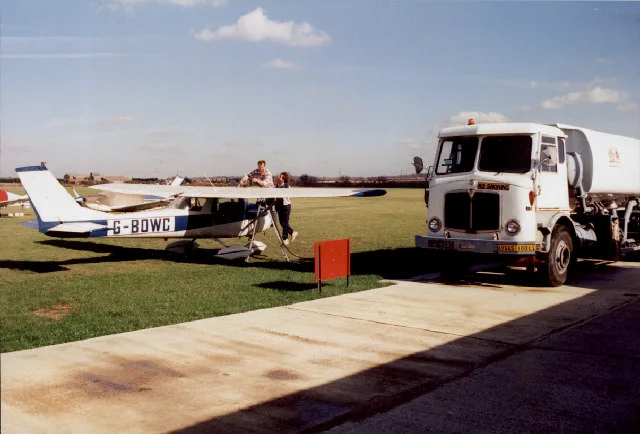

Use the model guide and serial-number reference to identify the aircraft's documented production context. Then establish the tanks and approved configuration actually present. Serial eligibility can help identify an option's applicability, but it does not prove installation. Aircraft records, equipment information and the controlling handbook remain necessary for a particular airplane.
Standard and Optional Tank Configurations
The configuration table retains the source's applicability wording and separates standard landplane, optional long-range and other documented contexts. These rows are not a menu of capacities that can be selected freely for any aircraft. The applicability field and configuration description are part of each value's meaning.
Optional tanks should be treated as an equipment question. An aircraft model appearing in a long-range source description does not establish that every aircraft of that model has those tanks. A buyer should reconcile the actual configuration with the records before relying on an advertised range or capacity. A pilot needs the current aircraft's applicable fuel information rather than a family-level option listing.
The performance guide retains long-tank range claims separately from other range metrics. That separation prevents a maximum-range result associated with one fuel configuration from appearing to describe every aircraft sharing the model name. Where source conditions are missing, this reference leaves them unresolved.
| Applicability | Configuration | Total gal | Usable gal | Unusable gal | Published Range Fuel | Reserve Basis | Note | Source |
|---|---|---|---|---|---|---|---|---|
| 150 landplane | Standard | 26 | 22.5 | 3.5 | 22.5 | Early published pages often no reserve | - | [1] |
| 150 Patroller / long range | Long range | 38 | 35 | 3 | 35 | Early published pages often no reserve | Secondary configuration reference | [2] |
| 150G-K seaplane | Standard | 26 | 21.5 | 4.5 | - | - | Different usable fuel | T3R51 |
| 150M later | Standard | 26 | 22.5 | 3.5 | 22.5 | 1976-77 published 45 min @45% power | - | [1] |
Total, Usable and Unusable Fuel
Total fuel describes the stated tank capacity. Usable fuel is the quantity represented as available for the source's applicable operation, while unusable fuel remains a distinct part of the fuel and weight accounting. These quantities should not be interchanged in a comparison, a research note or an aircraft-loading discussion.
A source can express unusable fuel in volume or in a weight-related field. Preserve the units and the source's treatment. Do not silently convert a quantity or substitute an assumed fuel weight when the controlling document uses a specific basis. The weight-and-balance reference keeps fuel and oil treatment alongside the applicable loading context.
A usable-fuel figure is not a legal reserve. Reserve assumptions belong to the particular performance or planning context. When a source range figure includes a stated reserve basis, keep it attached. When no basis is established, the figure cannot be advertised as a range with a reserve already accounted for. This distinction matters both in technical comparisons and in how an owner describes an aircraft to a prospective buyer.
Model-Year Fuel Differences
A model-year specification can provide useful historical fuel context, but its meaning depends on the model and configuration described. A standard-fuel entry and an optional-fuel entry should remain separate even where they appear in the same summary. The model-year table below preserves those labels rather than selecting whichever number is larger.
A long-running model designation can span more than one year and more than one published description. Serial ranges and the correct handbook help identify which source applies. The specifications guide explains why a year summary is not automatically the controlling document for every aircraft built under the same official model.
| Year | Model(s) | Fuel Std | Fuel Optional | Notes | Source |
|---|---|---|---|---|---|
| 1959 | 150 | 26 gal | - | Published secondary model-year summary. | [1] |
| 1960 | 150 | 26 gal | 38 gal Patroller | Detailed secondary page. | [2] |
| 1961 | 150A | 26 gal | 38 gal Patroller | Detailed secondary page. | [3] |
| 1962 | 150B | 26 gal | 38 gal Patroller | Takeoff 50 ft and cruise-condition conflict flagged. | [4] |
| 1963 | 150C | 26 gal | 38 gal Patroller | Detailed secondary page. | [5] |
| 1964 | 150D | 26 gal | 38 gal Patroller | Manufacturer Owner's Manual data. | [6] |
| 1965 | 150E | 26 gal | 38 gal Patroller | Detailed secondary page. | [7] |
| 1966 | 150F | 26 gal | 38 gal Patroller | Detailed secondary page. | [8] |
| 1967 | 150G | 26 gal | 38 gal Patroller | Detailed secondary page. | [9] |
| 1968 | 150H | 26 gal | 38 gal Patroller | A blank field means no value is provided here. | [10] |
| 1969 | 150J | 26 gal | 38 gal Patroller | Detailed secondary page. | [11] |
| 1970 | 150K/A150K | 26 gal | 38 gal Patroller | A150 certification limits stored separately. | [12] |
| 1971 | 150L/A150L | 26 gal | 38 gal Patroller | Detailed secondary page. | [13] |
| 1972 | 150L/A150L | 26 gal | 38 gal Patroller | Empty-weight line not established, not inferred. | [14] |
| 1973 | 150L/A150L | 26 gal | 38 gal | Detailed secondary page. | [15] |
| 1974 | 150L/A150L | 26 gal | 38 gal Patroller | Detailed secondary page. | [16] |
| 1975 | 150M/A150M | 26 gal | 38 gal | Use the applicable D1033-13 handbook for performance figures. | [17] |
| 1976 | 150M/A150M | 26 gal | 38 gal Patroller | Long-range fuel source typo excluded and logged. | [18] |
| 1977 | 150M/A150M | 26 gal | 38 gal Patroller | Detailed secondary page. | [19] |
- [1] 1959 model-year specification page
- [2] 1960 model-year specification page
- [3] 1961 model-year specification page
- [4] 1962 model-year specification page
- [5] 1963 model-year specification page
- [6] 1964 150 Owner's Manual
- [7] 1965 model-year specification page
- [8] 1966 model-year specification page
- [9] 1967 model-year specification page
- [10] 1968 model-year specification page
- [11] 1969 model-year specification page
- [12] 1970 model-year specification page
- [13] 1971 model-year specification page
- [14] 1972 model-year specification page
- [15] 1973 model-year specification page
- [16] 1974 model-year specification page
- [17] 1975 model-year specification page
- [18] 1976 model-year specification page
- [19] 1977 model-year specification page

Fuel and Oil in Weight-and-Balance Records
The fuel/oil table preserves tank configuration, usable and unusable quantities, arms and empty-weight treatment where established by the source. These fields belong together. A usable-fuel value should not be detached from its loading context and combined with an arm from another model or tank arrangement.
Empty-weight treatment also requires attention. A published convention for fuel or oil does not establish how a particular aircraft's latest weight-and-balance record was prepared. The actual report and equipment list need to be read as a coherent record. Adding or subtracting quantities without checking that basis risks double-counting or omitting weight.
This page provides research context rather than a loading calculator. It does not infer current empty weight, installed tank configuration or an aircraft-specific CG result from the serial number. Owners and pilots should use the actual aircraft documentation, while mechanics investigating a configuration change must preserve the appropriate records and approval context.
| Family / Serial | Tank Config | Total gal | Usable gal | Unusable gal/lb | Fuel Arm | Oil Capacity | Oil Arm | Empty Weight Treatment | Source |
|---|---|---|---|---|---|---|---|---|---|
| Early 150 through 150M S/N 15077005 / A1500609 | Standard | 26 | 22.5 | 3.5 gal / 21 lb | 40 | 6 qt | -13.5 | TCDS: unusable fuel included, undrainable oil 0 lb; actual weighing procedure adds required oil per handbook definition. | [1] |
| Early 150 seaplane eligible serial context | Standard | 26 | 21.5 | 4.5 gal / 27 lb | 40 | 6 qt | -13.5 | Seaplane-specific unusable fuel. | [1] |
| 150M later serials | Standard | 26 | 22.5 | 3.5 gal / 21 lb | 40 | 6 qt; 7 qt with filter | -13.5 | Certificated empty weight includes full oil 11.3 lb. | [2] |
| 150M | Long range | 38 | 35 | 3.0 gal / 18 lb | 40 | same | -13.5 | Tank installation has equipment net-change plus fuel change. | [2] |
Seaplane Fuel Context
Seaplane entries belong to their approved configuration. They must not be generalized to ordinary landplanes merely because the model letters overlap. A serial range can identify where a configuration was eligible, but installation and current approval records are needed to establish that the aircraft being researched has that configuration.
Fuel, weight and performance information must then be kept consistent with the same configuration. A seaplane weight entry, a landplane fuel assumption and a different model's range figure do not form a supported technical description simply because each number appears somewhere in the family data. The propeller applications similarly preserve landplane and seaplane distinctions.
For a buyer researching an aircraft that has changed configuration, historical records and current status may tell different stories. A past float installation does not establish the present fuel or loading configuration. Retain the date and scope of the records instead of allowing one historical entry to determine every current specification.
Reims and Argentine Applicability
Reims identities and Argentine designations remain separate from the U.S. model groups. A broadly similar aircraft or an equivalent-looking handbook is not enough to transfer a fuel specification. The Reims certification reference and Argentine serial mapping reference explain why identity relationships need to be preserved.
Where exact configuration evidence is absent, this page does not fill the gap with the nearest U.S. fuel value. That omission does not mean the aircraft has no defined capacity. It means the reference has not established the relationship required to make the claim. The controlling aircraft and authority documents remain the next research step.
Fuel Systems, Maintenance and Installed Equipment
Tank capacity is only one part of fuel-system research. The systems guide describes factory architecture and production transitions, while the known-issues reference distinguishes inspection concerns from confirmed defects. Neither a capacity match nor a system description proves the present condition of tanks, lines or associated components.
Component or modification conditions can also matter for airworthiness-directive applicability. An airframe model alone is not enough to establish every fuel-related requirement. Exact applicability and aircraft evidence must be checked, and a record of eligibility is not a record of compliance.
Maintenance history should therefore be considered separately from capacity. An aircraft can match a factory fuel configuration while still requiring record review or inspection to establish current condition. Conversely, a documented approved alteration may change the appropriate source context. The serial is a starting point for both questions, not their final answer.

Interpreting Fuel-Related Performance Claims
A range claim needs its usable-fuel, power, altitude and reserve context. Total tank capacity alone cannot establish that range. Optional long-range tanks may change the fuel basis represented by a source, but a capacity comparison does not establish an aircraft's actual endurance under unspecified conditions.
The performance tables retain different range metrics rather than combining them into a single headline. A maximum-range figure and a cruise-range figure can describe different conditions. The appropriate comparison keeps those differences visible and identifies where a source has not supplied enough information for a direct comparison.
Does a model's optional capacity prove my aircraft has long-range tanks?
No. It establishes an eligible or published configuration, not installation. The aircraft's equipment and records must establish which tanks are present and which documentation applies.
Can unusable fuel be ignored in weight and balance?
The relevant source and aircraft record determine the treatment. Do not omit it merely because it is not included in a usable-fuel performance quantity. Read the fuel/oil accounting with the actual empty-weight basis and loading documentation.
Which reference should be used for a specific aircraft?
Use the matching handbook and current aircraft records, including any applicable supplements and alterations. The manuals guide helps identify publication classes, and the Cessna 150 reference connects capacity research with the rest of the aircraft configuration.
Investigating a Long-Range-Tank Claim
An advertisement describing long-range tanks should lead to a configuration and records check before any range comparison. The model's historical option entry establishes that the configuration appears in the source context. It does not establish which tanks are on the aircraft, whether its documents reflect that arrangement or which published performance result applies.
Once the configuration is established, keep the source's total and usable quantities separate. Then follow the appropriate weight-and-balance treatment and the performance record's reserve basis. These are linked research questions, but they are not one number. An optional capacity cannot by itself establish available payload, practical endurance or a reserve allowance.
This distinction is also useful when comparing a standard landplane with an approved seaplane configuration. A shared model letter does not make their fuel and weight assumptions interchangeable. The configuration label must remain attached throughout the comparison. If records are incomplete, the reference should identify the missing evidence rather than silently select the larger capacity or longer range. That produces a more accurate description of the aircraft and a clearer next step for an owner, pilot or buyer.
Explore the Applicable Model References
Follow the aircraft identity before applying a technical figure. Each model reference preserves its own serial ranges and supported relationships; missing exact relationships are left unresolved rather than inherited from another model.
- Cessna 150 (150) - 1959-1960
- Cessna 150A (150A) - 1961
- Cessna 150B (150B) - 1962
- Cessna 150C (150C) - 1963
- Cessna 150D (150D) - 1964
- Cessna 150E (150E) - 1965
- Cessna 150F (150F) - 1966
- Cessna 150G (150G) - 1967
- Cessna 150H (150H) - 1968
- Cessna 150J (150J) - 1969
- Cessna 150K (150K) - 1970
- Cessna A150K Aerobat (A150K) - 1970
- Cessna 150L (150L) - 1971-1974
- Cessna A150L Aerobat (A150L) - 1971-1974
- Cessna 150M (150M) - 1975-1977
- Cessna A150M Aerobat (A150M) - 1975-1977
- Reims/Cessna F150F (F150F) - 1966
- Reims/Cessna F150G (F150G) - 1967
- Reims/Cessna F150H (F150H) - 1968
- Reims/Cessna F150J (F150J) - 1969
- Reims/Cessna F150K (F150K) - 1970
- Reims/Cessna FA150K Aerobat (FA150K) - 1970
- Reims/Cessna F150L (F150L) - 1971-1974
- Reims/Cessna FA150L Aerobat (FA150L) - 1971
- Reims/Cessna FRA150L Aerobat (FRA150L) - 1972-1974
- Reims/Cessna F150M (F150M) - 1975-1977
- Reims/Cessna FRA150M Aerobat (FRA150M) - 1975-1977
- AMC / Argentine Cessna A-150L (A-150L) - 1972-1973
- AMC / Argentine Cessna A-A150L Aerobat (A-A150L) - 1972-1973