Cessna 150 and 152 Lighting: Equipment Identity and Rheostat Research
Cessna 150/152 lighting is an equipment-dependent installation. The retained architecture lists position or navigation lights, landing and taxi lights, beacon or strobe equipment, and cabin or panel lighting as equipped. That list describes the kinds of equipment found in the family; it does not establish that every aircraft has every item or that all installations share the same electrical arrangement.

Exterior lights and panel lights answer different questions
An exterior-light description helps identify visibility equipment on the aircraft. Panel and cabin lights concern illumination within it. A maintenance entry saying “lights repaired” can therefore be too broad to identify what work was done. Preserve the component or circuit named in the original entry whenever possible.
| Reference family | System ID | Domain | Subsystem | Factory Applicability | Architecture / Components | Operational Interface | Configuration Status | Primary Source |
|---|---|---|---|---|---|---|---|---|
| Cessna 150 | SYS-LIGHT | Electrical | Lighting | All, equipment varies | Navigation/position, landing/taxi, beacon/strobe and cabin/panel lighting as equipped. | Visibility/illumination. | Optional/equipment-list dependent. | [1] |
| Cessna 152 | SYS-LIGHT | Electrical | Lighting | All, equipment varies | Navigation/position, landing/taxi, beacon/strobe and cabin/panel lighting as equipped. | Visibility/illumination. | Optional/equipment-list dependent. | [1] |
- [1] 150 IPC 1970-77
The electrical systems reference supplies the broader voltage and circuit-protection context. A lamp or assembly must be researched within the actual installation, rather than selected from the aircraft family name alone. This overview does not prescribe electrical ratings or approve a replacement lighting assembly.

Panel rheostat information is conditional
The retained known-issue record identifies a rheostat concern on specified 150/F150 installations and points to AD 93-24-15. The local summary does not contain a complete equipment or serial list. It would therefore be inappropriate to label every Cessna 150 panel rheostat as affected or to infer that a 152 installation falls within that record.
| Reference family | Issue ID | Category | Title | Failure Mode | Affected Scope | Applicability Class | Severity | Operational Consequence | Detection / Prebuy Clues | Maintenance / Mitigation | Legal / OEM Status | Primary Source Ref | Reference | Prebuy Priority | Confidence | Notes |
|---|---|---|---|---|---|---|---|---|---|---|---|---|---|---|---|---|
| Cessna 150 | KI-056 | Electrical / Instruments | Instrument-panel rheostat installation | Specified rheostat installations on listed 150/F150 variants require inspection/modification/replacement. | Affected rheostat configuration on listed 150/F150 variants. | APPLIANCE / CONFIGURATION | MEDIUM-HIGH | Electrical overheating/failure or loss of panel-light control. | Identify rheostat P/N/configuration and compliance history. | Inspect/modify/replace per AD. | FAA AD - mandatory conditional | AD 93-24-15 | [1] | MEDIUM-HIGH | HIGH | Configuration-driven. |
Use the issue entry as a route to the underlying applicability evidence. An aircraft's panel may have been changed, and the relevant configuration can depend on the actual equipment. A modern-looking panel is not proof of a documented terminating action, while an original-looking control is not sufficient evidence of the exact affected part.
Optional equipment and later alterations
Compare the equipment list, installation entries and current component identification when researching lighting changes. An optional item in a parts or maintenance reference is a possible configuration, not an assertion that it was fitted to the aircraft when built. Later replacement technology also needs its own installation evidence; physical similarity and a matching mounting location do not establish approval.
This page makes no current product recommendation and supplies no merchant links. The retained material does not establish present parts availability, lamp life or comparative electrical consumption for specific replacement products.

Preparing a useful inspection request
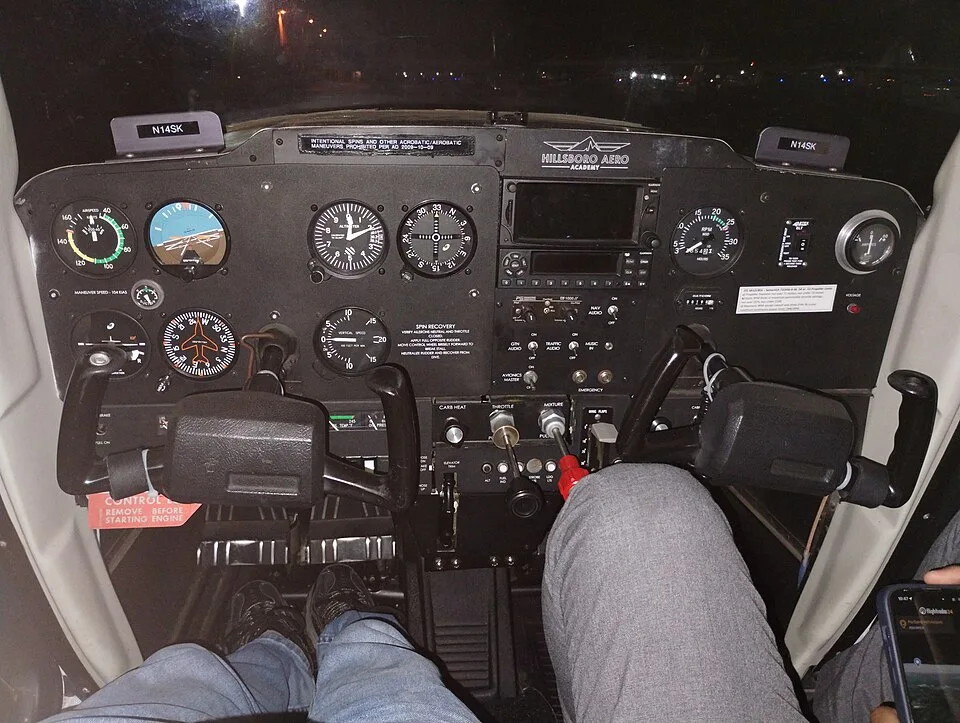
Separate the questions by equipment: which lights are fitted, what identifies their installation, what work is recorded, and whether the rheostat reference is relevant to the actual panel. That is more informative than treating one general lighting check as an answer about every circuit. The objective is to connect the visible equipment to its documentation and identify unresolved configuration questions, leaving operating checks and electrical maintenance to the applicable aircraft instructions.