Cessna 150E Model Reference
The 150E continues the Omni-Vision straight-tail phase identified in the chronology. Its special eligible serial is explicitly separate from the normal model-year sequence, leaving that special aircraft's year unresolved in the source. The distinction matters when a handbook or record search would otherwise assign every model identity to one ordinary production interval.
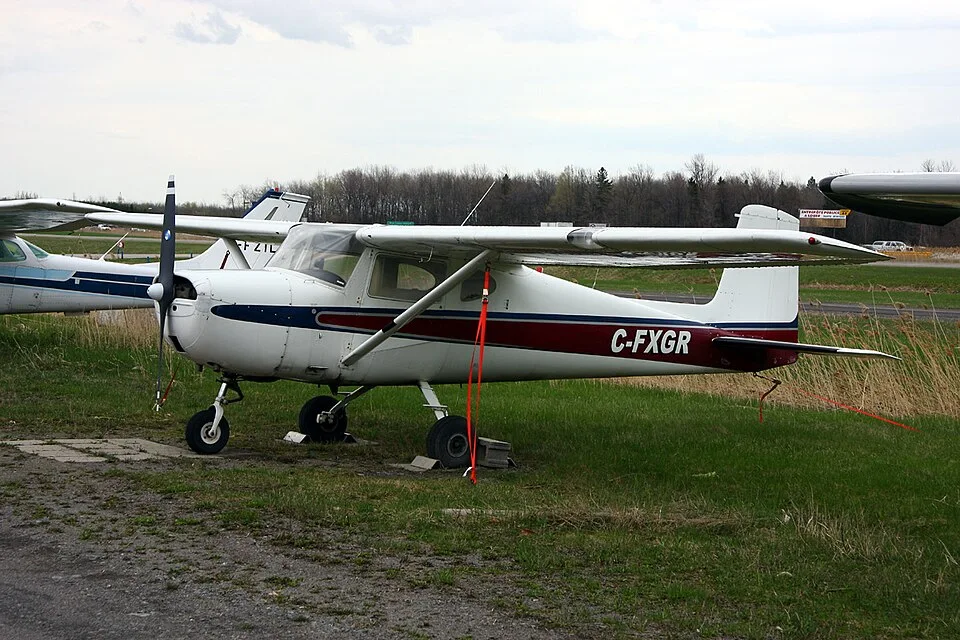

Rear-window cabin with the earlier flap arrangement
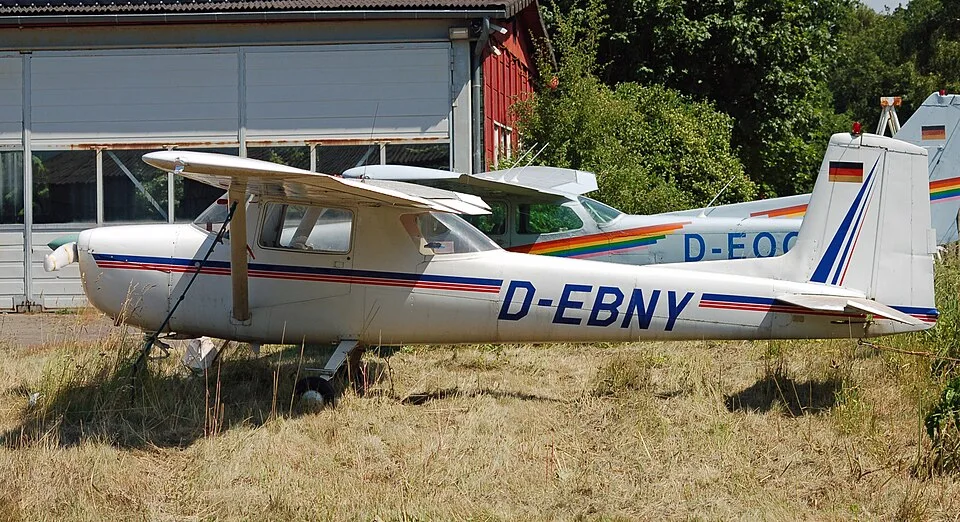
The 150E combines features that are easily separated by an oversimplified early-versus-late description. It has the rear-window generation introduced by the 150D, yet retains the straight-tail and manual-flap context before the 150F. Its 1965 place in the sequence is therefore useful even without evidence of a dramatic E-only redesign. A rear window does not, on its own, identify an electric-flap aircraft.
For a pilot or owner learning the family, the E-to-F comparison connects the visible tail change with the change in flap actuation. The E stays on the earlier side of that cockpit-system boundary while already belonging to the post-D loading generation. Its special serial and handbook details below then answer the narrower aircraft-identity question, which cannot be settled by recognizing those broad features in a photograph.
| Model Years | 1965 |
|---|---|
| Certification Category | Utility |
| Certified Serial Eligibility | 644; 15060773-15061532 |
| Type-design engine context | Continental O-200-A |
Generation and Certification
Comparing the 150E with the subsequent 150F should preserve the actual system-generation boundary rather than treat neighboring letters as equivalent. The available source describes the 150E within its own historical phase; later redesign features must not be inherited backward merely because both aircraft belong to the same family.
The 150E occupies a distinct position: it retains the Omni-Vision straight-tail generation immediately before the swept-tail 150F. Its 1965 identity does not mark the electric-flap introduction. The E shares the D-F 1,600-lb certified group, so the coming F redesign should not be presented as the point where that gross weight first appeared. The 1965 summary gives 33 ft 6 in span and 21 ft 7 in length. Those figures help describe the straight-tail aircraft, but they are not a substitute for the dimensions of an altered or differently equipped example.
| Model | TC | Category | Initial Model Approval Date | Core Cert Basis | Certification / Identity Note | Reference |
|---|---|---|---|---|---|---|
| 150E | 3A19 | Utility | 1964-06-18 | CAR 3 (1956-05-15) amended 3-4 | - | [1] |

Serial Numbers and Production
For 150E, the ordinary source assignments are 1965: 15060773 through 15061532. The special identifier 644 is assigned to 150E, with year recorded as Unresolved: Model identity confirmed; not assigned to a normal model-year range here. The serial guide retains source conflicts and exceptional identities alongside these intervals.
| Model Year | Official Model | Serial Start | Serial End | Excluded / Override Serials | Notes | Primary Source |
|---|---|---|---|---|---|---|
| 1965 | 150E | 15060773 | 15061532 | - | - | [1] |
| Serial | Legal Model | Model Year | Effect | Primary Source |
|---|---|---|---|---|
| 644 | 150E | Unresolved | Model identity confirmed; not assigned to a normal model-year range here. | [1] |
Engine, Propeller and Equipment Changes
The cabin-heat exchanger AD research boundary is unusually important within the E-model production context: the recorded range ends at 15061328, whereas ordinary 150E production continues through 15061532. Retain the actual right-hand exhaust-gas exchanger condition when following that lead. A range endpoint is not evidence that later aircraft have no heating-system inspection needs, and the short special serial 644 must not be forced into the numeric interval. The E's manual-flap architecture also directs a different maintenance enquiry from the electric motor and relay questions on the succeeding F model.
The 150E factory installation groups specify 1965: O-200-A, 100 hp at 2750 RPM; Unresolved: O-200-A, 100 hp at 2750 RPM. Its named propeller applications are 69CK-0-48L / -50L / -52L; 1A100/MCM6950; 1A101/DCM6950. Their diameter, static-RPM and configuration conditions are preserved together below.
| Origin | Model Year | Aircraft Model | Factory Engine | Installed hp | RPM Limit | First Serial in Group | Last Serial in Group | Applicability Basis | Aircraft Source |
|---|---|---|---|---|---|---|---|---|---|
| USA | 1965 | 150E | O-200-A | 100 | 2750 | 15060773 | 15061532 | Factory / type-design | [1] |
| USA | Unresolved | 150E | O-200-A | 100 | 2750 | 644 | 644 | Factory / type-design | [1] |
| Aircraft Model | Model Year / Config | Engine | Exact Propeller Application | Max Dia | Min Dia | Static Min | Static Max | Notes | Primary Authority |
|---|---|---|---|---|---|---|---|---|---|
| 150 through 150F | All | O-200-A | 69CK-0-48L / -50L / -52L | 69 | 67.5 | 2320 | 2470 | Sensenich application guide notes spinner/bulkhead for 69CK-0-52 installation. | [1] |
| 150 through 150F | All | O-200-A | 1A100/MCM6950 | 69 | 67.5 | 2375 | 2475 | - | [1] |
| 150 through 150F | All | O-200-A | 1A101/DCM6950 | 69 | 67.5 | 2500 | 2600 | - | [1] |
Specifications, Fuel and Loading
The published 1965 empty weights distinguish 970-lb Standard and 1,010-lb Commuter examples. Both sit beneath the same 1,600-lb certified limit, so the equipment version affects the illustrative remaining load without changing the legal model. The standard-fuel and Patroller entries need the same separation: capacity is an installation characteristic, not proof that maximum fuel and maximum cabin load can be carried together. For performance comparisons, the E's own year-specific cruise, climb and runway headlines remain preferable to borrowing a more detailed D- or F-model table simply because the certified limits are grouped.
The normal E interval bridges an important exhaust-heater effectivity endpoint, while the following F begins a different flap and tail generation. Those two boundaries should not be merged into one claim that all E aircraft share one heater arrangement or all later models are free of exhaust concerns. The E year summary retains the Patroller option, but its standard certified group remains 26 gallons total and 22.5 usable. The 80- versus 120-lb baggage transition has already occurred with the D generation. For an E buyer, this places the aircraft accurately between the early fastback limits and later electric-flap systems without claiming an unsupported E-only redesign.
| Models | Category | Speed Basis | Vne | Vno | Va | Vfe | MTOW Land lb | MTOW Sea lb | Baggage lb | Source |
|---|---|---|---|---|---|---|---|---|---|---|
| 150D/150E/150F | Utility | CAS | 141 kt / 162 mph | 104 kt / 120 mph | 95 kt / 109 mph | 87 kt / 100 mph | 1600 | - | 120 | [1] |
| Models / Serial Applicability | Config | Category | Ramp lb | TO lb | Landing lb | Fwd CG light | Light wt | Fwd CG heavy | Heavy wt | Aft CG | Baggage | Datum / Reference | Leveling | Source |
|---|---|---|---|---|---|---|---|---|---|---|---|---|---|---|
| 150D, 150E, 150F | Land | Utility | - | 1600 | 1600 | 31.5 | 1280 | 32.9 | 1600 | 37.5 | 150D/E: 120 lb @ +65; 150F: 120 lb ref W&B data | Certified datum / later handbook firewall Sta 0.0 | Top of tailcone | [1] |
| Year | Model(s) | Max Speed | Cruise | ROC SL | Ceiling | Published Gross / MTOW | Published Empty Weight | Baggage | Notes | Source |
|---|---|---|---|---|---|---|---|---|---|---|
| 1965 | 150E | 125 mph | 125 mph @75% / 7500 ft | 670 fpm | 12,650 ft | 1600 lb | 970 Std; 1010 Commuter | 120 lb | Detailed secondary page. | [1] |

Performance and Comparison Conditions
One published 150E example is 1965 cruise speed: 125 mph (power % 75; altitude ft 7500). The table keeps each metric's year, units, power, altitude, fuel and reserve columns together. Use the performance guide to distinguish headline comparisons from handbook operating calculations; no unreported condition is supplied for 150E.
| Year | Model | Value | Units | Power % | Altitude ft | Fuel Usable gal | Reserve Basis | Obstacle ft | Condition Note | Source |
|---|---|---|---|---|---|---|---|---|---|---|
| 1965 | 150E | 125 | mph | - | - | - | - | - | Published headline value | [1] |
| 1965 | 150E | 125 | mph | 75 | 7500 | - | - | - | Published headline condition | [1] |
| 1965 | 150E | 670 | fpm | - | - | - | - | - | - | [1] |
| 1965 | 150E | 12650 | ft | - | - | - | - | - | - | [1] |
| 1965 | 150E | 735 | ft | - | - | - | - | - | - | [1] |
| 1965 | 150E | 1385 | ft | - | - | - | - | 50 | - | [1] |
| 1965 | 150E | 445 | ft | - | - | - | - | - | - | [1] |
| 1965 | 150E | 1055 | ft | - | - | - | - | 50 | - | [1] |
Manuals, Maintenance and Research
D251-13 is the 150E owner's-manual family. An aircraft carrying an E-model plate and a later manual should therefore prompt an effectivity check, especially if the manual describes electric flaps or a swept vertical tail. The E is useful to buyers who want to understand the Omni-Vision generation without collapsing it into the later F configuration. Records of cabin-heat work, current weight and balance, and actual propeller identification add more to that comparison than an unsupported claim that every successive model letter was faster or structurally superior. The positive 150E publication leads are 1965: D251-13 (Owner's Manual).
| Family / Year | Model | Publication | Document Class | Serial / Year Effectivity | Authority Basis | Operational Status | Special Boundary | Reference |
|---|---|---|---|---|---|---|---|---|
| 1965 | 150E | D251-13 | Owner's Manual | 150E 1965 | CAA TAR 98/08 | Authority-recognized publication family | No adjacent-year borrowing | [1] |
Related Models and Technical Research
The 150E-versus-150F comparison separates the manual-flap, straight-fin aircraft from the subsequent electric-flap redesign.