Cessna 150D Model Reference
The 150D marks the documented Omni-Vision and higher-gross-weight generation in the U.S. chronology. The associated dimensions include configuration notes, while the serial-break record identifies eligibility for optional heavy-duty nose-gear equipment. These are related pieces of model history but they do not establish one universal installed configuration.
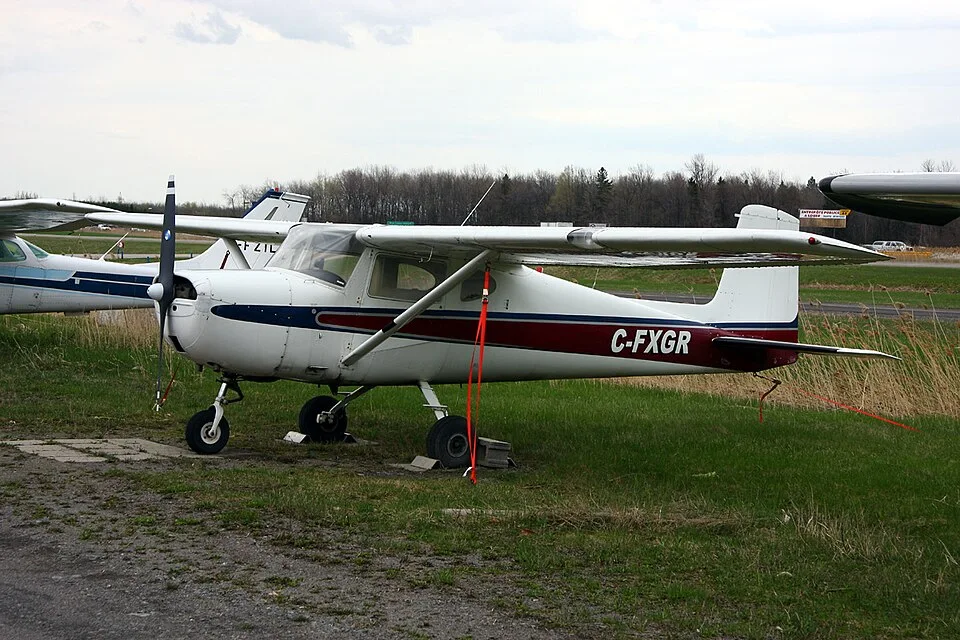

The rear window arrives before the swept tail
The 1964 150D is a major turning point between the fastback 150C and the continuing straight-tail 150E. Omni-Vision rear glazing changes the cabin's relationship with the rear fuselage, while the certified-weight and baggage context also moves beyond the early group. The straight fin remains part of this generation. Rear window and swept tail are therefore two separate steps in the family's evolution.
Seen from inside, the glazing change concerns the view around the occupants. Seen through the records, the loading change concerns permissible combinations of people, fuel and baggage. Neither observation establishes an individual airplane's useful load or a measured field of view. The cabin article and weight references develop those different consequences of a model that can otherwise be summarized too narrowly as the rear-window 150.
Its Continental installation also illustrates continuity through a visible redesign: the D did not need a new engine-family name to become a different certified model. The engine, propeller and optional nose-gear details below remain separate installation questions. Following the D into the E and then F makes that distinction clear: not every important change happened at the same transition.
| Model Years | 1964 |
|---|---|
| Certification Category | Utility |
| Certified Serial Eligibility | 15060088-15060772 |
| Type-design engine context | Continental O-200-A |
Generation and Certification
The practical comparison with the preceding early group is therefore both structural and documentary. Certified weights belong to the applicable group, dimensions belong to the stated configuration, and optional equipment remains an installation question. A record of eligibility is not evidence that the option was fitted or remains on the aircraft today.
The 1964 150D moves the standard aircraft from the 1,500-lb early group to a 1,600-lb landplane limit, alongside the Omni-Vision rear-window and baggage changes. That is a more consequential comparison with the 150C than the unchanged O-200-A power rating suggests. Vne rises from the early group's 136 kt to 141 kt CAS, Va from 92 kt to 95 kt CAS and Vfe from 74 kt to 87 kt CAS; Vno remains 104 kt CAS. These are group-specific certified comparisons, not a claim that the cockpit's indicated scale can be read without its calibration information.
| Model | TC | Category | Initial Model Approval Date | Core Cert Basis | Certification / Identity Note | Reference |
|---|---|---|---|---|---|---|
| 150D | 3A19 | Utility | 1963-07-19 | CAR 3 (1956-05-15) amended 3-4 | - | [1] |

Serial Numbers and Production
For 150D, the ordinary source assignments are 1964: 15060088 through 15060772. The serial guide retains source conflicts and exceptional identities alongside these intervals.
| Model Year | Official Model | Serial Start | Serial End | Excluded / Override Serials | Notes | Primary Source |
|---|---|---|---|---|---|---|
| 1964 | 150D | 15060088 | 15060772 | - | - | [1] |
Engine, Propeller and Equipment Changes
The D-model heavy-duty nose-gear entry starts at 15060477. The wording is optional-equipment eligibility, so the later portion of the serial range cannot be advertised as universally fitted with heavy-duty gear. Identify the nose-gear installation when evaluating an aircraft intended for demanding ground operations. The published 21 ft 7 in length is qualified by the standard spinner, which makes it inappropriate to turn that dimension into an exact measurement for every propeller/spinner combination. The propeller table itself preserves three applications whose static-RPM limits differ even though their maximum diameter is 69 inches.
The 150D factory installation groups specify 1964: O-200-A, 100 hp at 2750 RPM. Its named propeller applications are 69CK-0-48L / -50L / -52L; 1A100/MCM6950; 1A101/DCM6950. Their diameter, static-RPM and configuration conditions are preserved together below.
| Origin | Model Year | Aircraft Model | Factory Engine | Installed hp | RPM Limit | First Serial in Group | Last Serial in Group | Applicability Basis | Aircraft Source |
|---|---|---|---|---|---|---|---|---|---|
| USA | 1964 | 150D | O-200-A | 100 | 2750 | 15060088 | 15060772 | Factory / type-design | [1] |
| Aircraft Model | Model Year / Config | Engine | Exact Propeller Application | Max Dia | Min Dia | Static Min | Static Max | Notes | Primary Authority |
|---|---|---|---|---|---|---|---|---|---|
| 150 through 150F | All | O-200-A | 69CK-0-48L / -50L / -52L | 69 | 67.5 | 2320 | 2470 | Sensenich application guide notes spinner/bulkhead for 69CK-0-52 installation. | [1] |
| 150 through 150F | All | O-200-A | 1A100/MCM6950 | 69 | 67.5 | 2375 | 2475 | - | [1] |
| 150 through 150F | All | O-200-A | 1A101/DCM6950 | 69 | 67.5 | 2500 | 2600 | - | [1] |
| Year | Model | Serial Trigger | Change | Effectivity | System | Source |
|---|---|---|---|---|---|---|
| 1964 | 150D | 15060477 | Optional heavy-duty nose gear eligibility noted | 15060477 and on | Landing gear | [1] |
| Year | Model | Major Change | Serial Specific? | Source |
|---|---|---|---|---|
| 1964 | 150D | Omni-Vision rear window, gross-weight and baggage increases | Partly | [1] |
Specifications, Fuel and Loading
The 1964 handbook summary lists empty-weight examples of 970 lb Standard, 975 lb Patroller, 990 lb Trainer and 1,010 lb Inter-City. At the same 1,600-lb limit, those examples produce different theoretical useful loads before any present-day equipment changes. This illustrates why the gross-weight increase does not translate into one universal payload claim. Standard usable fuel is 22.5 gallons in the certified group. The range evidence separately includes 35 usable gallons for long tanks, with no-reserve conditions; its larger range figure does not establish either installed tanks or a dispatch fuel allowance.
The higher certified weight and baggage entry make the D a natural boundary in an early-aircraft buying comparison, but the loading envelope still matters. The D-F group records a forward CG limit of 31.5 at the light 1,280-lb point and 32.9 at 1,600 lb, with an aft limit of 37.5 in the supplied datum context. Those are points in a weight-dependent envelope, not a single CG number to attach to every load. The supporting weight-and-balance row also separates baggage wording for D/E from the F reference. A larger baggage allowance cannot be evaluated independently of the actual aircraft's empty weight, occupant stations and moment calculation. The 1964 performance evidence illustrates a second kind of comparison: its 122-mph cruise headline retains 75-percent power and 7,500-ft altitude, while the 490-mile standard-fuel and 760-mile long-tank cruise-range entries retain a no-reserve basis. The range difference is therefore explicitly a fuel/configuration comparison, not a faster D model or a larger legal cabin load. An owner investigating the D's advantages over the C can make a concrete distinction between approved load limits, historical equipment weights, fuel carried and performance conditions. Each contributes something different, and the nose-gear option remains another independent configuration question.
| Models | Category | Speed Basis | Vne | Vno | Va | Vfe | MTOW Land lb | MTOW Sea lb | Baggage lb | Source |
|---|---|---|---|---|---|---|---|---|---|---|
| 150D/150E/150F | Utility | CAS | 141 kt / 162 mph | 104 kt / 120 mph | 95 kt / 109 mph | 87 kt / 100 mph | 1600 | - | 120 | [1] |
| Models / Serial Applicability | Config | Category | Ramp lb | TO lb | Landing lb | Fwd CG light | Light wt | Fwd CG heavy | Heavy wt | Aft CG | Baggage | Datum / Reference | Leveling | Source |
|---|---|---|---|---|---|---|---|---|---|---|---|---|---|---|
| 150D, 150E, 150F | Land | Utility | - | 1600 | 1600 | 31.5 | 1280 | 32.9 | 1600 | 37.5 | 150D/E: 120 lb @ +65; 150F: 120 lb ref W&B data | Certified datum / later handbook firewall Sta 0.0 | Top of tailcone | [1] |
| Year | Model(s) | Max Speed | Cruise | ROC SL | Ceiling | Published Gross / MTOW | Published Empty Weight | Baggage | Notes | Source |
|---|---|---|---|---|---|---|---|---|---|---|
| 1964 | 150D | 125 mph | 122 mph @75% / 7500 ft | 670 fpm | 12,650 ft | 1600 lb | 970 Std; 975 Patroller; 990 Trainer; 1010 Inter-City | 120 lb | Manufacturer Owner's Manual data. | [1] |


Performance and Comparison Conditions
One published 150D example is 1964 cruise speed: 122 mph (power % 75; altitude ft 7500). The table keeps each metric's year, units, power, altitude, fuel and reserve columns together. Use the performance guide to distinguish headline comparisons from handbook operating calculations; no unreported condition is supplied for 150D.
| Year | Model | Value | Units | Power % | Altitude ft | Fuel Usable gal | Reserve Basis | Obstacle ft | Condition Note | Source |
|---|---|---|---|---|---|---|---|---|---|---|
| 1964 | 150D | 125 | mph | - | - | - | - | - | Published headline value | [1] |
| 1964 | 150D | 122 | mph | 75 | 7500 | - | - | - | Published headline condition | [1] |
| 1964 | 150D | 670 | fpm | - | - | - | - | - | - | [1] |
| 1964 | 150D | 12650 | ft | - | - | - | - | - | - | [1] |
| 1964 | 150D | 735 | ft | - | - | - | - | - | - | [1] |
| 1964 | 150D | 1385 | ft | - | - | - | - | 50 | - | [1] |
| 1964 | 150D | 445 | ft | - | - | - | - | - | - | [1] |
| 1964 | 150D | 1075 | ft | - | - | - | - | 50 | - | [1] |
| 1964 | 150D | 490 | mi | 75 | 7500 | 22.5 | No reserve | - | Condition-preserved published range | [2] |
| 1964 | 150D | 760 | mi | 75 | 7500 | 35 | No reserve | - | Condition-preserved published range | [2] |
| 1964 | 150D | 565 | mi | - | 10000 | 22.5 | No reserve | - | Condition-preserved published range | [2] |
| 1964 | 150D | 885 | mi | - | 10000 | 35 | No reserve | - | Condition-preserved published range | [2] |
Manuals, Maintenance and Research
The D's normal interval runs from 15060088 through 15060772 and its publication lead is D208-13. That makes it possible to separate the model-wide rear-window generation from the narrower nose-gear option and from an aircraft-specific equipment history. Exhaust-heater research still depends on the named right-hand exchanger and the AD's exact serial range. The later swept-fin and electric-flap generation starts with the 150F, so those features should not be described as D-model changes. For a C-to-D buying comparison, the strongest evidence is the certified loading/speed change plus the actual cabin, baggage and nose-gear configuration. The positive 150D publication leads are 1964: D208-13 (Owner's Manual).
| Family / Year | Model | Publication | Document Class | Serial / Year Effectivity | Authority Basis | Operational Status | Special Boundary | Reference |
|---|---|---|---|---|---|---|---|---|
| 1964 | 150D | D208-13 | Owner's Manual | 150D 1964 | CAA TAR 98/08 | Authority-recognized publication family | Manufacturer-manual performance exists | [1] |
Related Models and Technical Research
The 150C-to-150D transition places the Omni-Vision change alongside its loading context. The baggage reference explains why a compartment limit is not an available-payload figure.